350.org is a global grassroots movement to solve the climate crisis we are currently in. They organize campaigns, projects and actions that are lead by people in 188 countries. They are headquartered in Brooklyn, New York. The organization has launched chapters in many cities around the world that work on movements of their own as well as being part of the international movements.
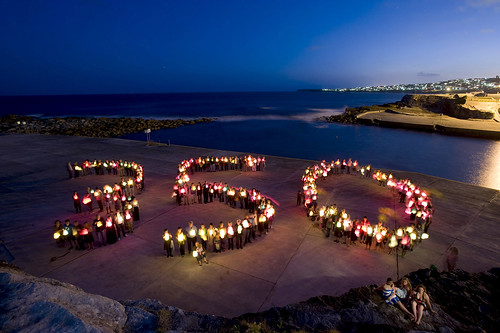
350.org
“If humanity wishes to preserve a planet similar to that on which civilization developed and to which life on Earth is adapted, paleoclimate evidence and ongoing climate change suggest that CO2 will need to be reduced from [current levels] to at most 350 ppm.”
- Dr. James Hansen
A little history...
350.org was founded by a group of university friends in the U.S. Bill McKibben is the president and co-founder of 350.org, and is also an environmental author and activist. He wrote one of the first books on climate change available to the public, The End of Nature (1989). May Boeve is the executive director and another co-founder of 350.org. She has also been involved in other climate action campaigns.
The group started organizing in 2008. They coordinated days of action to link activists and other organizations. Some of these days included International Day of Climate Action 2009, Global Work Party 2010, Moving Planet 2011, and Climate Impacts Day 2012. Their event in 2009 was one of the most widespread days of political action in history.
Their goals...
350.org is working to lower CO2 in the atmosphere from the current level of 400 parts per million to below 350 parts per million. Scientists say we must improve to below 350 parts per million if we want a livable planet. 350.org is helping people come together to push our leaders to work on ways to fix the CO2 problems.
With so many languages around the wold, 350.org wanted to create a video to convey their message to everyone.
Campaigns they've worked on...
350.org has been a part of many different movements. Some of their major works include fighting coal power plants in India, stopping the Keystone XL pipeline in the U.S., and divesting public institutions from fossil fuels.
The team...
Besides the countless number of activists and member of 350.org, they do have a staff, Board of Directors, International Advisory Council, and U.S. Advisory Council. They also work with hundreds of allies and partners around the
world, including: Better Future project, Sierra Club, Rainforest Action
Network, NRDC, Greenpeace, Friends of the Earth, Energy Action Coalition, CREDO Mobile, Climate Reality Project, Citizens Climate Lobby, and AVAAZ.org.
350 in Wisconsin...
With an organization that operates in 188 countries, there is a need for many different chapters. You can see where all the chapters are in the world using their interactive map: http://350.org/map/. Wisconsin has two chapters, in Madison and Milwaukee. The Milwaukee chapter was launched in January 2013. They hold meetings the first Tuesday of every month at the Urban Ecology Center for people who want to get involved. They also use email to convey information about events. You can also find them on Facebook: 350 Milwaukee. The Madison chapter was launched in January 2012. They meet the first Monday of every month at 1704 Roberts Court. You can also find them on Facebook: 350 Madison Climate Action Team.
350 Milwaukee...
The Milwaukee chapter works on many projects to mitigate climate change due to CO2 emissions. Recently, they held a protest for the People's Climate Movement National Day of Action at the U.S. Federal Courthouse in Milwaukee. They rose awareness with signs, speeches, and music. They have also been doing a lot of work with the oil train routes that travel along the waterways in Milwaukee. An oil spill near the Milwaukee River or Lake Michigan would be detrimental to the freshwater ecosystems, so they are trying to get the trains rerouted. The chapter and its activists do travel to other states for events, like Minnesota for the Tar Sand March back in June. As the Milwaukee chapter demonstrates, each area focuses their efforts on ways to improve climate change their geographic area. You can find out more about their events on their Facebook page.
Sources:

I remember an event in Gordon Park for 350.org in 2008 or 2009. Attempting to challenge more powerful actors in climate changing industries is tough business for grassroots organizers but 350.org is still around after all of these years. I like their creative strategies like divestment from fossil fuel stocks and young leadership development programs. The Fossil fuel corporations spent many years manufacturing consent to operate like they have, and now 350 is trying to change the culture. I doubted the efficacy of organizations like 350 at first, but how do you eat an elephant? One bite at a time. The decentralized structure allows leaders to be developed and elevated quicker than many of the traditional top down structures of older environmental orgs.
ReplyDeleteThe bit you mention about the oil trains being rerouted around our bodies of water-what an accident waiting to happen that would be if something spilled. This could be one of the biggest catches that any organization or actor has had in the city. The fish and plant life in the Milwaukee River and Lake Michigan would be completely wiped out if oil got into the water.
ReplyDeleteOverall, you did an awesome job showing everything that 350.org has done for many different communities and states across the U.S. I really had no problem understanding what exactly they do for people. I think something that would've helped your post out a bit more was getting into some hardcore details on some things. What steps exactly are they taking against the Keystone? Also, how do you fight coal power plants overseas?
Great post with lots of useful information and based off the info, I definitely think this is an organization that's taking appropriate steps towards a better, greener Earth.
I was not familiar with 350.org before reading your post. I really like the idea of global grassroots movements with small local specialized roots. Their website offers a lot of different resources and ways for someone to get involved or start their own movement. This can be a powerful tool in helping organize action on smaller scales to demand action on larger scales. The work with oil train routes really caught my eye. I did not realize that oil train routes ran along the waterways in Milwaukee. Just picturing an oil spill along the river or Lake Michigan would just be devastating.
ReplyDeleteI think your blogg post was very insightful as I'm not familiar with this organization. Im curios to where these train routes go exactly and what they actually are doing to achieve change regarding this issue. I remember a few years back that a WE energies coal power plant exploded. The plant is located on the bluffs of lake Michigan right near Ryan road, the south side area. Due to the explosion, there was a large amount of coal ash released into lake Michigan. I remember walking down by the beach inbetween bradford and lakebluff and i saw black clumps of coal ash washed up onto the beach. So i can only imagine the devistation of an oil spill would have are Milwaukees livelyhood as far as the dire affect it would have on the drinking water we rely on as well as the destruction of an entire ecosystem that has a massive significance on this planet. I'm curious to do some more research on this organization. Do they contribute in trying to sway politicians and power companies as far as where they are alowed to build their plants?
ReplyDelete